News & Insights
Empty mileage in vehicle movements - and how to cut it
Empty mileage in vehicle movements - and how to cut it

James Griffin
Share
Every operator knows the empty return leg is waste. A driver repositions to the next job. A transporter runs back to base with nothing on it. A car gets moved just to be somewhere else tomorrow. Everyone feels it. Almost nobody measures it.
That’s a problem, because empty running is the single biggest controllable cost in moving vehicles, and it’s the one cost that never appears as a line on a single invoice.
This page covers what empty mileage actually costs, why it stays hidden, and how planning across your whole operation cuts it.
What empty mileage is
Empty mileage - empty running, or “deadheading” in freight - is any distance a driver or vehicle covers with nothing productive attached. Not broken down, not delayed. Just going somewhere useful with no useful cargo, while carrying full fuel, labour and maintenance cost and earning nothing against it.
It’s a well-documented problem in road freight. GB-registered HGVs travelled 5,897 million kilometres empty in 2025 - 31% of all vehicle kilometres, loaded and empty (Department for Transport, Domestic road freight statistics 2025).
Driven-vehicle movements have exactly the same structural gap, with one difference: almost nobody counts it, because counting it means seeing across every movement, every driver and every site at once.
Why it stays invisible
The reason this cost is so easy to ignore is that it never shows up anywhere you’d look for it.
Every movement has a cost you can see - the quote, the mileage rate, the driver’s day. But the empty leg is folded into all of it. It isn’t itemised, isn’t quoted separately, isn’t flagged. It’s absorbed into the rate you pay, the hours you book, the fuel card at the end of the month. You’re paying for it on every job. You’ve simply never been shown the total.
So before you chase a cheaper per-mile rate, look at how many of your miles are earning nothing. Shaving 5% off a rate is a negotiation. Cutting your empty miles is a structural saving that compounds every month.
Where empty miles actually come from
When you look at where empty miles come from, they aren’t random. They cluster - around the same return legs, the same repositioning runs from auction sites or prep centres, the same end-of-day moves back to base. The same routes, the same times, the same shape, week after week.
That matters, because random waste is hard to attack and predictable waste isn’t. If most of your empty running happens on a known set of legs, it stops being an unavoidable cost of doing business and starts being a planning problem, one you can actually do something about.
How to cut empty mileage: four levers
Empty mileage is a planning failure, so the fix is planning - specifically, planning every movement against every other movement instead of one job at a time. Four levers do most of the work:
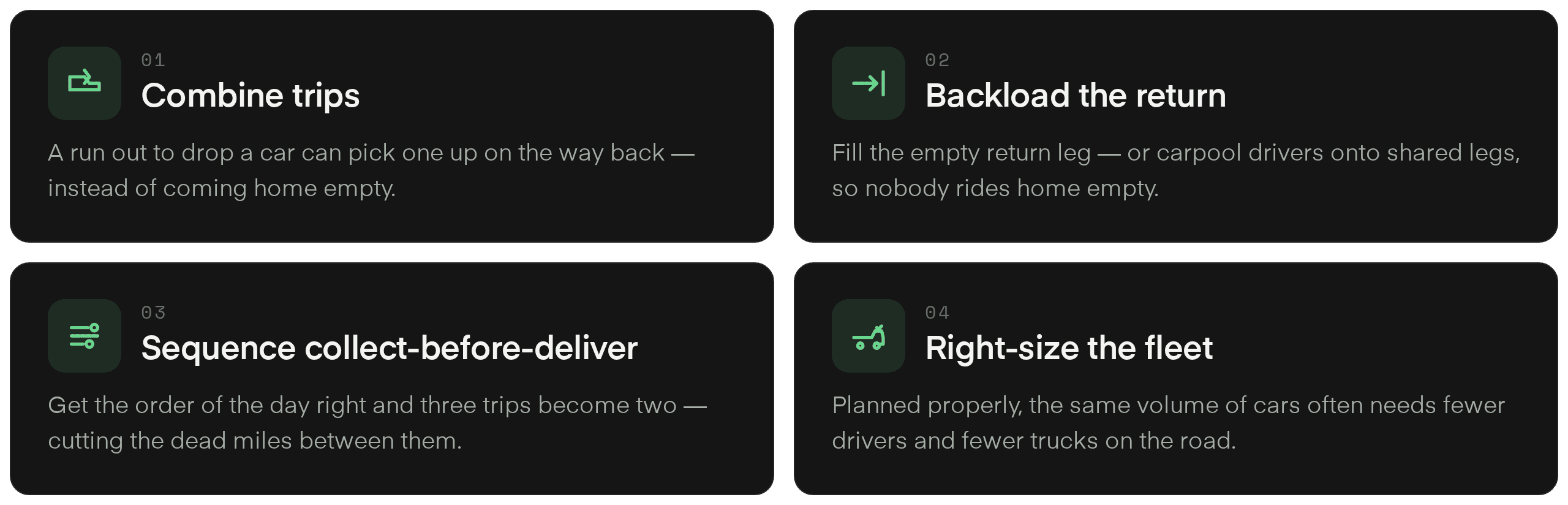
None of that comes from a better rate card. It comes from planning the moves at all.
What it's worth
Three examples from operators who planned across the network instead of job by job.
5.5 to 7.7 movements per driver shift. Barretts of Canterbury improved average vehicle movements per shift from 5.5 to 7.7 across a quarter by optimising its internal trade plate drivers - a 40% throughput gain that cut the cost of each movement by 21%. Same drivers, same pay, less dead time between jobs.
1,241 movements that never happened. Glyn Hopkin, which operates over 35 locations across the south-east, made 1,241 fewer vehicle movements over six months - a 40% reduction in used car movements, saving £112,628. The cheapest empty mile is the one you never drive.
£2,800 recovered in a month. One regional trade plate business, carpooling drivers back onto shared return legs rather than running them home empty - £2,800 in the first month across roughly 380 movements, about £7.37 recovered on every one. None of the three came from a better rate card. All three came from planning the moves together. Jigcar reduces empty mileage by more than 20% on average across customer operations. Proof points drawn from over 150,000 vehicle movements planned in Jigcar.
Measure yours first
The first step costs nothing: measure it. Pull your empty or near-empty miles as a share of the total for one recent month. Whatever the number is, it’s almost certainly higher than you’d guess, and now you can see it, you can plan around it.
Our transport cost calculator will estimate it from your own movement volumes, and the 2026 cost benchmark shows where empty running sits in the full anatomy of what a move costs.
How Jigcar cuts empty mileage
The Jigcar platform plans movements across your whole network at once, so empty legs get spotted - and cut - before they’re driven. The Optimiser combines trips, sequences routes to collect before delivering, and right-sizes the fleet to the work actually in front of it. The Strategy Assistant surfaces your empty-mile share on demand, traceable back to real movements, so it stops being a number you guess at.
And it doesn’t run on autopilot. The Optimiser and the Assistants do the legwork and show their working; the plan comes back to your planner to check. You review. You approve. Nothing moves without you.
If you’d like to see what your own empty-mile figure looks like, book a demo and we’ll walk through it using your movement volumes.
See how the Optimiser works here.


