News & Insights
Agentic AI in Automotive Logistics
Agentic AI in Automotive Logistics

Rupert Wood
Share
Every vehicle movement is a margin decision. Get the load, the route or the return leg wrong and cost leaks out of the operation a car at a time. The promise of agentic AI in vehicle logistics is that software can now take on the reversible, everyday decisions that leak that margin — spotting the gaps in a plan, surfacing the lanes that lose money, working out what to move next — and hand them back for a person to approve. It's a real shift, and one of the most over-claimed corners of AI vehicle logistics software. This piece is what agentic AI actually does here, what it shouldn't, and how to tell the real thing from the label.
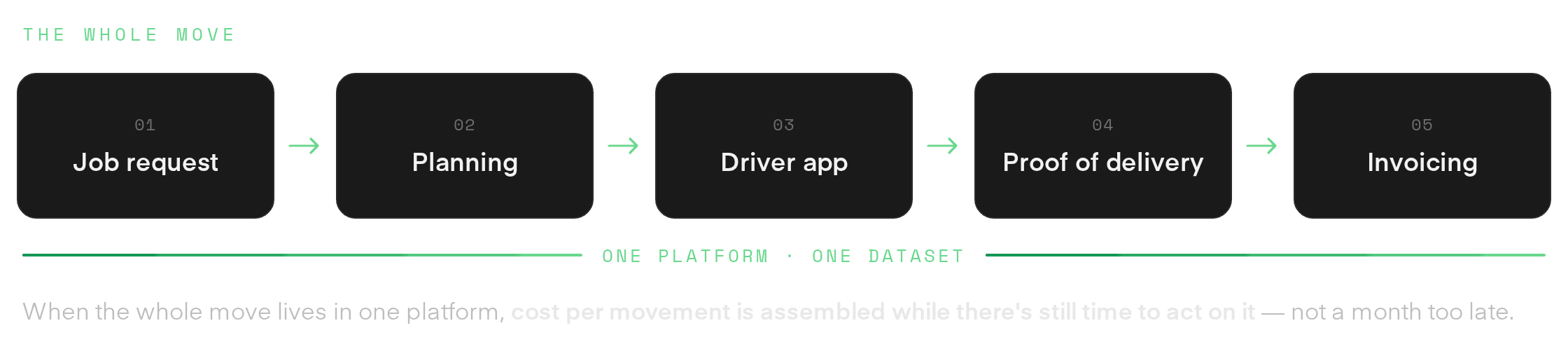
Vehicle logistics is a margin-thin, empty-mile-heavy, fragmented business, and its tooling is stuck. Load boards list loads but don't plan the move, and most planning still runs on spreadsheets and phone calls. That gap — between listing work and actually planning it — is where margin is made or lost. An AI-powered transport management system that connects the whole chain, from job request through planning, the driver app and proof of delivery to invoicing, is what turns wasted miles and idle assets back into recovered margin.
What is agentic AI in vehicle logistics?
Three very different things get called AI in a transport stack, and telling them apart matters before you trust any of them with a decision.
Rule-based automation | Chatbot / copilot | Optimisation algorithms | Agentic AI / LLM | |
How it works | Follows fixed instructions. If a job is unassigned by 5pm, send it to a default provider. | Answers when you ask. Prompt it for last month's on-time rate and it hands back a number. | Solves a defined maths problem — the cheapest set of loads, say — when someone sets it running on clean data. | Reads your operation, reasons across it, surfaces the gaps and opportunities, and can set the planning running. |
Who starts it | A trigger someone configured once. | You do — and you have to know what to ask. | You do, with the problem and the data framed for it. | Works on its own initiative, within limits you set. |
What you get back | The action it was told to take. | An answer to the question you typed. | The optimal answer to the exact question posed — no more, no less. | The gaps worth acting on, and a plan you can check, with its working shown. |
When things change | Does what it was told, whether or not that still makes sense today. | Nothing. It does nothing on its own. | Re-solves only when someone re-runs it with new inputs. | Adapts when a car isn't ready or a job cancels. |
Verdict | Reliable, and blind. | Useful, but reactive. | Powerful, but narrow — it optimises; it doesn't decide what to optimise. | Reasons across your actual operation. |
What separates the real thing from the label is whether it reasons across your actual operation and shows its working — not whether the marketing says “AI”.
Why vehicle logistics needs an AI-powered transport management system
Moving cars between stores, auctions, compounds and customers is still largely planned by hand — a spreadsheet built each morning, drivers confirmed over the phone, and a plan that lives in one person's head. As the number of sites, moves and providers grows, that approach doesn't just slow down; it quietly costs money. A modern AI-powered transport management system exists to close exactly these four gaps.
Manual, rebuilt-daily planning. Loads, routes and driver shifts are worked out by hand every day, so plans are slower to build, harder to re-plan when a car isn't ready, and rarely the most profitable arrangement of the work available.
Empty and part-loaded miles. Transporters run with slots unfilled and return legs empty, carrying full fuel, labour and maintenance cost with no revenue against them — the single biggest controllable cost in vehicle transport.
Work leaking to third parties. Moves get sent out at a premium when an in-house driver had space that afternoon, because no one could see the whole picture in time to plan around it.
Fragmented systems. Job requests, planning, the driver app, proof of delivery and invoicing sit in separate tools, so cost per movement is never assembled while there's still time to act on it — the answer arrives a month too late to change anything.
Load boards don't close this gap; they widen it. A load board tells you a load exists. It doesn't decide which vehicles go on which transporter, in what loading order, on which route, assigned to which driver — the decisions where the margin actually sits. Closing that gap is a planning problem — and it's the reason agentic AI is arriving in vehicle logistics now: software that reads the whole operation and works out what to move, when and on whom, with route optimisation doing the maths underneath.
What the numbers say: the economics of vehicle logistics
Cost and margin, not “time saved”, are the only honest anchor for this business, because the unit economics are brutal. (Figures below are UK/European; the dynamics they describe — thin margins, empty running, driver scarcity, fragmentation — apply to vehicle logistics in every market.)
Margins are thin enough that one bad load matters. UK road freight runs on wafer-thin profit — typically around 2%, and reported as low as 1.6% for leading operators (RHA; Hatmill, 2025). At that level, a single badly-built load can turn a lane from profit to loss.
Too many miles earn nothing. GB-registered HGVs ran close to a third of their distance empty last year (DfT, 2025) — every one of those miles carrying full fuel, driver and maintenance cost with no revenue against it. The fix is rarely more trucks; it's better planning.
You can't just add drivers. More than a quarter of UK HGV firms report driver vacancies (DfT, 2025), and in European vehicle logistics only one new driver joins for every seven who leave (ECG, via Ship2Shore, 2026). Getting more from the fleet you already run is the only lever left.
The market is fragmented, and so is the tooling. In European finished vehicle logistics (FVL), the ten largest providers hold just 38.4% of the market between them (Automotive Logistics, 2024) — a long tail of operators running on load boards and spreadsheets, not planning platforms.

Agentic AI is not optimisation — here's the difference
Agentic AI and optimisation often get lumped together, but they're two different technologies — and the difference is the thing worth getting straight.
Optimisation is bounded maths. An optimisation engine takes the movements, drivers, constraints and rules and computes a plan — the fullest loads, the tightest routes, which job goes on which driver, in what order. It's powerful and it's narrow: it solves the exact problem posed, when someone runs it. It doesn't decide what to solve, and it won't tell you where you're losing money.
Agentic AI is reasoning, not maths. Agents read across the whole operation and work out what's worth acting on — the gaps, the opportunities, the lanes bleeding margin — answer questions in plain English, and adapt when a car isn't ready or a job cancels. They work on their own initiative within the limits you set, and hand their work back for a person to approve.

Most vehicle logistics software has neither done properly: a load board that lists work but plans nothing, or a chatbot bolted onto a dashboard. The rare platforms that have both are where the two combine — optimisation computes the plan, agentic AI reasons across it and can set a fresh run going when you ask. But they stay two different technologies, and “agentic” should mean the reasoning, not optimisation with a new label.
What agentic AI does in vehicle logistics
Surfaces gaps and opportunities. Reads across the day's plan and the wider operation to find the unfilled slots, the moves that could combine, and the work best kept in-house rather than sent to a 3PL at a premium.
Decomposes cost per movement. Reads across the job system, driver app, proof of delivery and invoicing to rank the lanes and customers where margin is bleeding — so you know where to act first.
Answers questions in plain English. Ask what a lane really costs, or how many drivers you'll need next month, and get an answer with the working shown — no report request, no month's wait.
Sets an optimisation run going. Kicks off a run from a plain-English request and reshapes the plan when the day changes — so building the plan is a conversation, not an afternoon of tabs and phone calls.
Flags exceptions for a person. Assembles the evidence behind a damage claim or an invoicing anomaly and routes it to someone with the case already built, rather than resolving it on its own.
Three decisions, up close
Load building — the margin decision hiding in plain sight. A planner building a nine-car load balances weight across axles, height clearance, delivery sequence (last on, first off) and where the truck needs to be for its next move. Get it wrong and you either leave a slot empty, revenue left behind, or strand the truck far from its next load, running it back empty. The optimisation engine assembles the feasible loads — respecting weight, height and sequence — and an agent surfaces the next-move opportunity, ranks the options by margin and hands the planner a defensible choice. You can ask for the day's plan in plain English; nothing dispatches that a person hasn't approved. Reversible, bounded, observable and low-stakes: the textbook decision to hand over early.
Cost per movement — the analysis a planner never has time to run. Knowing which lanes and customers leak margin means pulling data from the job system, the driver app, the proof-of-delivery record and invoicing — and it's never assembled while there's still time to act. An agent reads across those systems, decomposes cost per movement, and surfaces the handful of lanes and customers where margin is bleeding, ranked by money at stake. The planner still decides what to do: renegotiate, re-lane, or drop it. No irreversible action, high value: a natural early win.
Damage and proof-of-delivery exceptions — the one to keep a person on. A damage claim is high-stakes, judgement-heavy and legally consequential. The right role for an agent is to assemble the evidence — pickup versus delivery condition, timestamps, photos, the signed handover — flag the anomaly, and route it to a person with the case already built. Handing this to software to resolve on its own is exactly the kind of overreach — claiming autonomy on a decision that doesn't have the shape for it — that gets a system switched off after one bad call.
Agent washing: cutting through the AI hype
Intent is near-universal; deployment is not. 94% of supply chain professionals plan to use AI for decision support within two years (ABI Research, 2025), yet human-in-the-loop is the clear preference: 54% want AI to recommend while a person decides, and only 10% would trust it to decide alone — even as confidence grows (RELEX State of Supply Chain 2026). Gartner's warning is the backdrop: it expects more than 40% of agentic AI projects to be scrapped by the end of 2027 on cost, unclear value or weak controls, and reckons only a sliver of the vendors claiming to be “agentic” are building the real thing — the rest “agent washing”, rebranded chatbots and automation (Gartner, June 2025).
In vehicle logistics specifically, the software that autonomously runs a car-hauling operation is a demo, not a deployment. What's real today is narrower and more useful: an optimisation engine that builds loads, sequences routes, handles automated dispatch and produces ETAs, and agents that surface gaps and opportunities, analyse cost per movement and flag invoicing exceptions — all recommending, with a planner who approves. The overreach isn't claiming autonomy; it's claiming it evenly, on decisions that don't have the shape for it.
How to choose AI vehicle logistics software
Start where a wrong answer is cheap and quickly seen. Point agentic AI first at the reversible, bounded, observable decisions — surfacing gaps and opportunities, flagging invoicing exceptions, analysing cost per movement, and setting optimisation runs going for a planner to approve. Benchmark before and after on the metrics that move money: empty-mile percentage, cars per load, cost per movement, days to invoice.
Then add the analysis layer. Turn on cost-per-movement, capacity and demand planning as recommend-only. The bar to widen: the system should demonstrably recover margin on one metric — empty miles, load factor or cost per movement — inside a quarter. If it can't, it's pointed at the wrong decision.
Widen the envelope as trust is earned. Only once the small, reversible decisions are trusted should the software act automatically within tighter bounds. Keep the one-way doors — damage and claim resolution, provider awards, large yard reorganisations — on a person.
What to look for in a transport management system, whether you're a dealer group or a carrier
A full operational platform, spanning job request through planning, the driver app and proof of delivery to invoicing. A load board or a point routing tool leaves the data fragmented — which is exactly what breaks agentic reasoning.
Traceability. Every recommendation should show what it read and why it landed there, so it holds up to the planner, to finance, and — for a damage claim — to a dispute.
A test for “agent washing”. Ask to see the agent reason on your own data, not a canned demo. If it can't explain a load or a cost-per-movement call, it's a chatbot with a routing button.
Autonomy matched to the decision, with human approval as the default. The keen-junior model — agent proposes, planner approves — is both what the market wants and what keeps the system trusted.
ROI where it shows up: margin recovered, empty miles cut, load factor lifted, cost per movement reduced, cash freed by faster invoicing.
Jigcar: one platform for the whole move
Jigcar is an AI-powered transport management system (TMS) for vehicle logistics: job requests, planning, the driver app, proof of delivery and invoicing in one platform. Most of what breaks agentic AI in this space comes back to one thing — the reasoning has to see the whole operation, and in most stacks it can't. Jigcar is built the other way round, so its agents reason across the whole move, not one system's slice of it, and cost per movement is assembled while there's still time to act on it.
Underneath sits the Optimiser, a real optimisation engine, not rules-based automation dressed up as AI. It does the planning: builds the loads, sequences the routes, sizes the fleet the work actually needs and cuts the empty legs — the decisions where the margin sits. Jigcar's agents (the Planning and Strategy Assistants) work alongside it: they surface the gaps and opportunities, answer the questions you'd normally wait a month for with every number traceable back to a real movement, and let you set a fresh optimisation run going in plain English when the day changes.
And it keeps the shape right. The engine and the agents do the hard work and hand it back. You review. You approve. Nothing moves without you. That's the model this whole piece argues for — autonomy matched to the decision, a person on the calls that carry real stakes — built into the platform rather than bolted on.
Bring your own movements, your own drivers or carriers, and one question you can't currently answer. We'll show you the plan it builds and the answer it finds, on your own data. Book a demo today.
Frequently Asked Questions
What is agentic AI in vehicle logistics?
Agentic AI reads your actual movements, fleet and rules and reasons across the whole operation. In vehicle logistics it works with the optimisation engine that computes the plan — which cars go on which transporter, in what order, on which route — surfacing the gaps and opportunities and handing an explainable result back for a person to approve. Unlike a chatbot (which only answers when asked) or rule-based automation (which follows fixed triggers), it works on its own initiative within the limits you set, and adapts when a job cancels or a car isn't ready.
What is an AI-powered transport management system (TMS) for vehicle logistics?
A vehicle logistics TMS connects the whole move - job request, planning, driver app, proof of delivery and invoicing - in one platform. The AI-powered kind adds an optimisation engine that builds loads and sequences routes, plus agents that surface gaps and opportunities and analyse cost per movement, so the plan is computed and interrogated in one place instead of pieced together across spreadsheets and load boards.
What's the difference between agentic AI, a chatbot, and rule-based automation?
Rule-based automation follows fixed instructions and is reliable but blind. A chatbot or copilot answers questions you type but does nothing on its own. An optimisation algorithm solves one defined maths problem when you run it. Agentic AI reasons across your whole operation, works with the optimisation that builds the plan, shows its working, surfaces what to act on, and can set a run going when you ask.


