Back
Meet the Optimiser: the engine that optimises every vehicle movement

Rupert Wood
JIGCAR SHIPS #04 - The Optimiser
This is the fourth post in Jigcar Ships - a running series covering new features as they go live.
The automotive industry has load boards, marketplaces and freight tools bent to fit. What it never had was software that plans the move. Vehicle movement optimisation - deciding what moves, when, on which driver or truck, in what order - is the part automotive logistics never got software for. The Optimiser is that part.
Every year, millions of vehicles move that nobody will ever drive home from a showroom. Auction to lot. Prep centre to forecourt. Between stores inside a group. It's one of the largest, most repetitive logistics operations in any industry - and almost all of it is still planned by hand: a spreadsheet rebuilt each morning, a driver confirmed over the phone, a plan that lives in one person's head.
Every one of those plans is a margin decision. Get the load, the route or the return leg wrong and cost leaks out of the operation a car at a time.
Not a router. An optimisation engine.
A load board lists the work. A generic routing tool finds a road between two points. Neither one plans your day.
The Optimiser does. It's the AI engine at the core of Jigcar's Autoplan TMS - an intelligence layer that plans your entire operation at once, trade-plate drivers and multi-car transporters together, and finds the cheapest, most compliant way to move every car you're responsible for today.
That's a real optimisation engine, not rules-based automation dressed up as AI. It weighs every move against every other move - collection and delivery windows, priorities, driver hours, capacity, the return trip - all at once, and hands back a finished plan with its working shown.
No human planner can hold every combination of a busy day in their head. So they make a reasonable call and move on. That reasonable call is where the margin leaks: the empty leg nobody spotted, the two jobs run in the wrong order that became three trips instead of two, the car that ended up at the wrong site. The Optimiser does the one thing software is genuinely better at - solving the whole board at once.
What makes Jigcar's route and load optimisation different
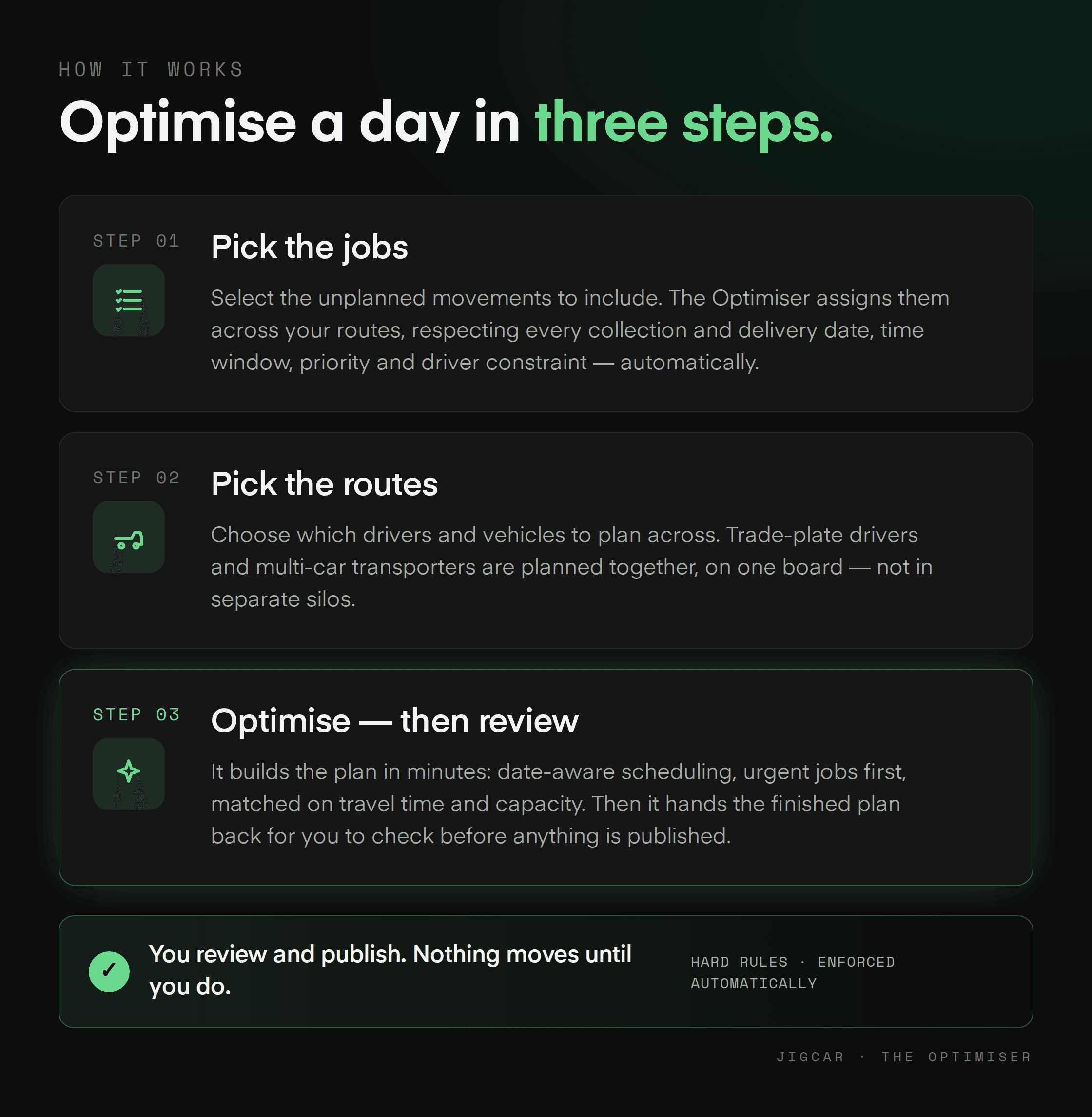
It plans legs and loads together. The Optimiser sequences trade-plate legs and transporter loads in a single pass, so return legs and part-loads never quietly go to waste.
It optimises for true cost per move. It weighs driver hours, fuel, return legs and transporter fill together, so every car moves the cheapest compliant way — not the way that was easiest to plan by hand.
It re-plans in seconds. When a job lands late or a transporter goes down, the Optimiser re-solves the whole board and hands back an updated plan you can trust. Not a patch — a fresh optimal plan.
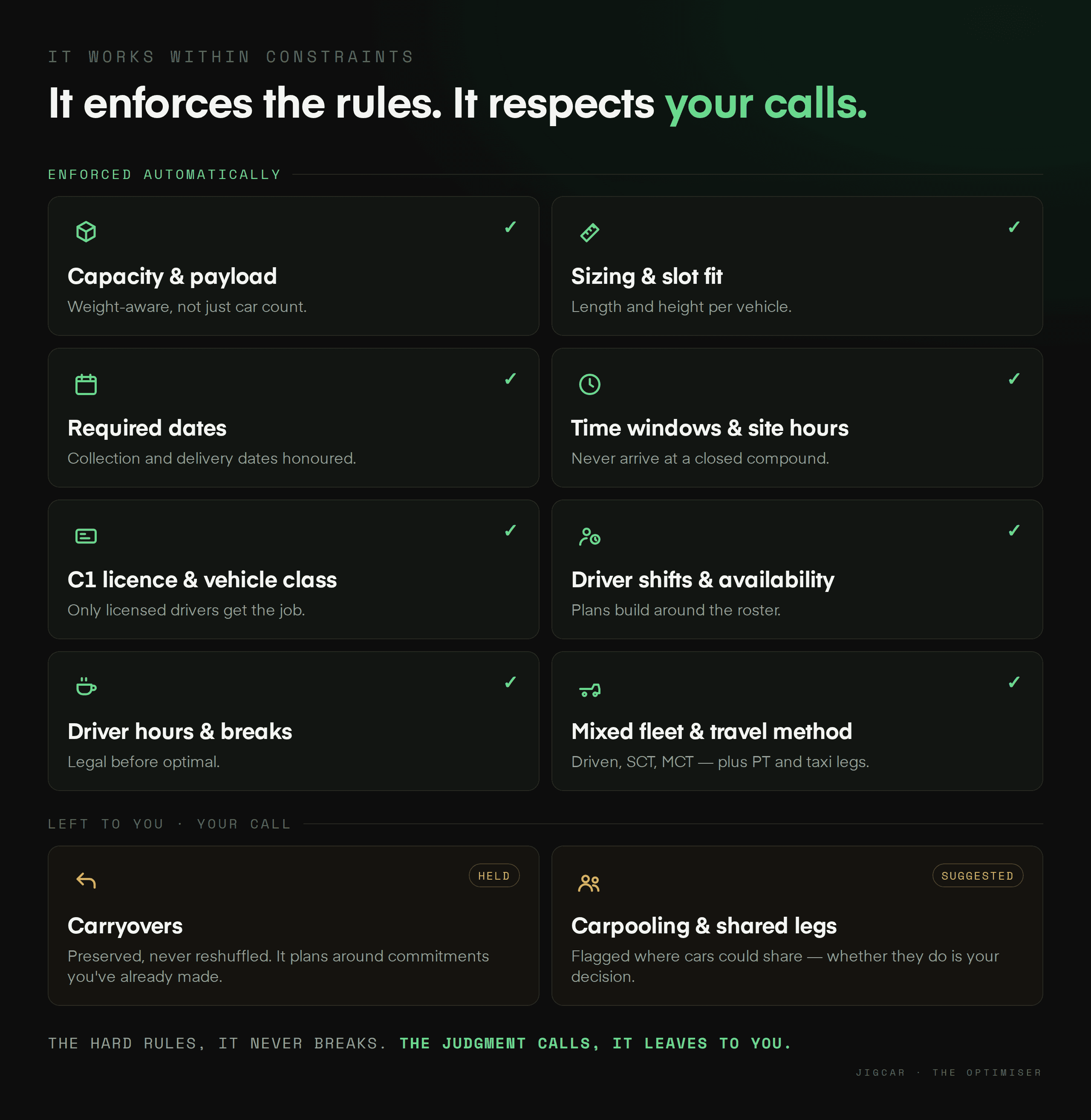
It respects the hard rules. Driver hours, HGV road restrictions and load compatibility are hard constraints, never afterthoughts. A plan that breaks them is never a plan the Optimiser will give you.
Built for automotive: why a car isn't a pallet
Generic route optimisation software doesn't speak automotive. This one was designed to.
A car is the rare piece of freight that can move itself. Depending on distance, cost and who's free, the same vehicle might be driven, trade-plated, loaded onto a transporter or subbed to a 3PL. Loading order, transporter dimensions, damage-sensitive handling, dealer and auction windows - the Optimiser understands all of it. Trade-plate, single-car and multi-car movements are first-class, each with its own speed, cost and capacity, tuned on real UK networks rather than parcel delivery. It's the same automotive-specific planning that powers Jigcar for dealer groups and transport providers.
The results: fewer empty miles, lower cost per move
The results show up where the money is.
One multi-site operation took a week's workload that used to need twelve drivers down to nine - same cars, same deadlines, three fewer people on the road. Elsewhere, transport bills have come down not through a better rate card, but by not making the moves that never needed to happen.
None of that comes from listing loads faster. It comes from planning them at all. Fewer empty miles. More paid movements in every driver's day. A lower cost per vehicle move - and the margin that was hiding in the plan all along.
You still run the day
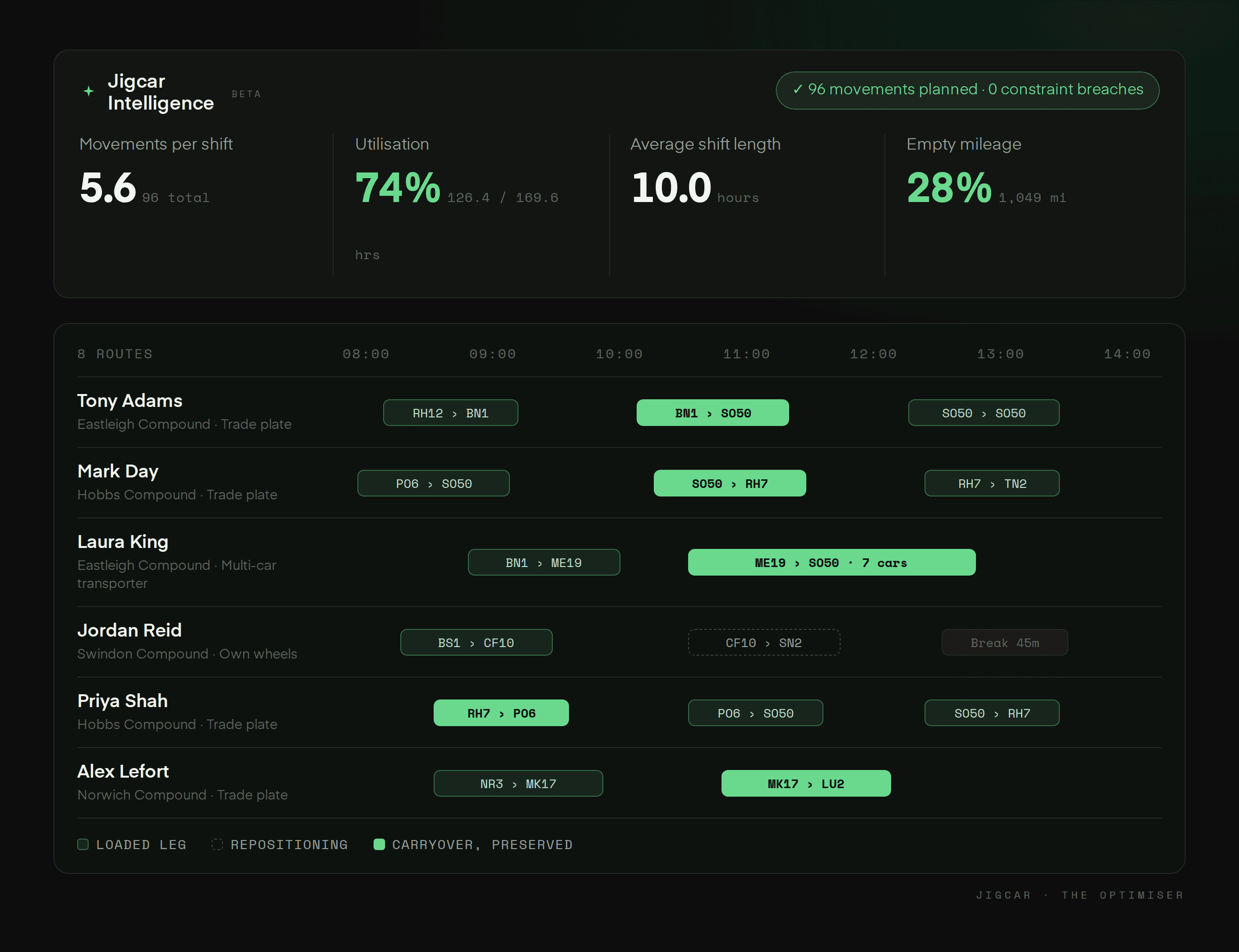
A planned day isn't an automated one. The Optimiser builds the plan. You review it. You publish it. Nothing moves until you do.
The point was never to take the decision out of human hands - it's to stop asking a person to do, by memory and under pressure, the one thing software does better: weigh every move against every other move at once.
See vehicle movement optimisation on your own routes. Book a walkthrough →
Frequently Asked Questions
What is vehicle movement optimisation?
How is the Optimiser different from a load board?
Does it work for trade-plate drivers and transporters?
Can it re-plan when the day changes?